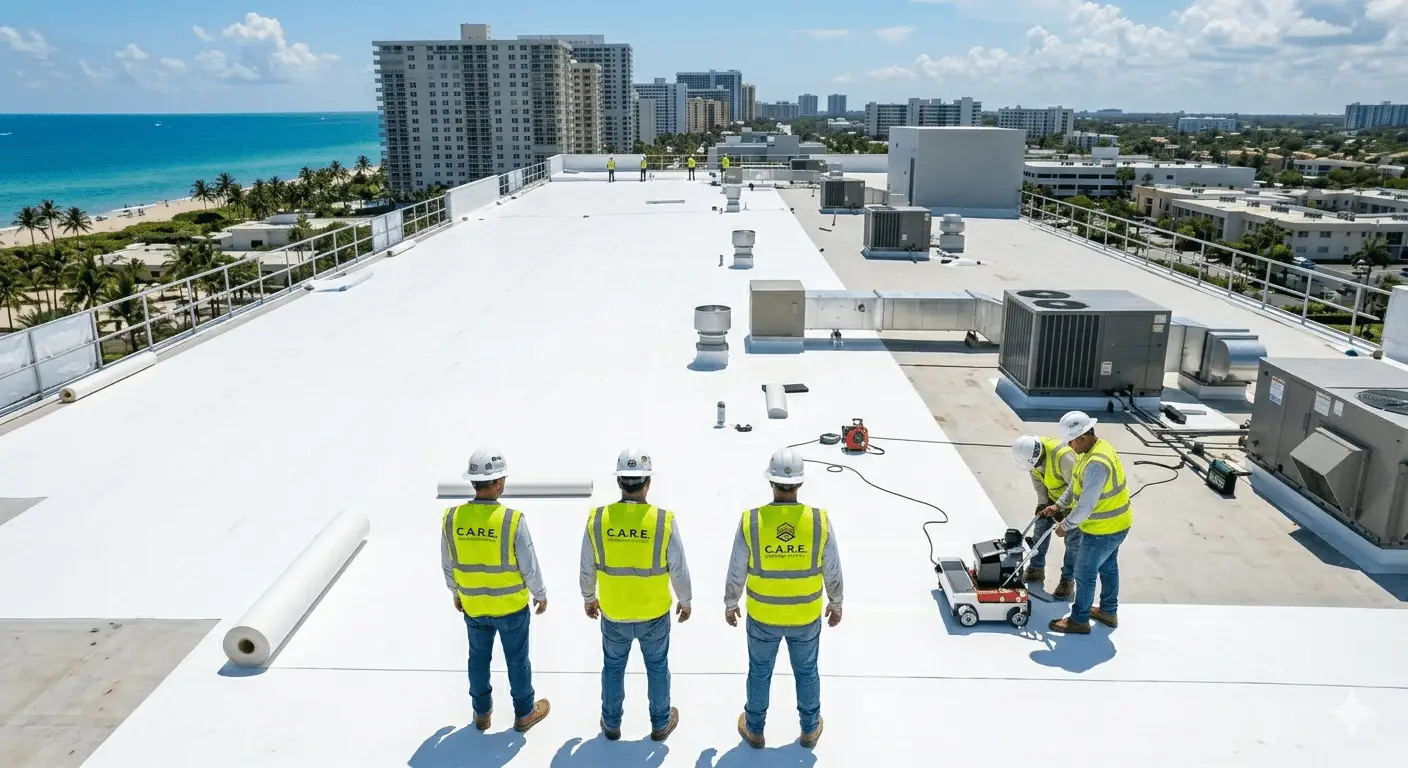
For most Florida businesses, the roof is not just a weather barrier. It is part of the energy bill.
In a hot, humid climate like South Florida, the roof takes direct sun for hours every day. If it absorbs too much heat, that heat moves into the building, pushes HVAC systems harder, and drives up cooling costs. That is why energy efficiency is no longer just a “nice to have” in commercial roofing in Fort Lauderdale, FL. It is one of the most practical ways to reduce long-term operating costs while also lowering the building’s environmental impact. The U.S. Department of Energy says cool roofs are designed to reflect more sunlight and absorb less solar energy than conventional roofs, which lowers roof temperature and reduces heat transfer into the building.
The good news is that Florida businesses have more than one path to better roof efficiency. Some buildings benefit most from reflective membranes. Others make sense for coatings, metal systems, or even vegetated roof assemblies in the right setting. The best option depends on the building, its use, its mechanical load, and how the roof is exposed to sun and rain. EPA notes that cool roofs can reduce air conditioning demand and help lower surrounding heat, while the Department of Energy emphasizes that actual savings depend on climate and building characteristics.
Why Energy Efficiency Matters More In Florida
Florida puts commercial roofs under constant thermal stress. A conventional dark roof can become extremely hot in direct sun, while a cool roof can stay significantly cooler under the same conditions. The Department of Energy notes conventional roofs can reach around 150°F or more on a sunny afternoon, while cool roofs reflect more sunlight and absorb less heat. EPA’s cool roof compendium also states that reflective roof products can remain roughly 50°F to 60°F cooler than traditional materials during peak summer conditions.
That temperature difference matters because a hotter roof usually means a hotter building envelope. The more heat the roof pulls in, the harder the HVAC system has to work to keep indoor conditions stable. In Florida, where cooling demand already runs high for much of the year, even modest gains in roof efficiency can have meaningful cost implications over time. Florida Solar Energy Center research has documented cooling energy savings from reflective roof surfaces in Florida buildings, reinforcing that roof reflectance can directly affect air-conditioning demand.
Cool Roofing Systems Are Often The First Place To Start
When people talk about energy-efficient roofing in Florida, cool roofing systems are usually the first category worth understanding.
A cool roof is built around high solar reflectance and high thermal emittance. In simple terms, that means it reflects more sunlight and releases absorbed heat more effectively than conventional roofing. DOE explains that this lowers roof temperature, and EPA notes that buildings with cool roofs use less air conditioning and can have more comfortable indoor temperatures.
For many low-slope commercial buildings, this can be achieved through reflective single-ply membranes, reflective coatings, or other high-reflectance roof surfaces. These systems are especially relevant in South Florida because they address the climate’s biggest energy challenge directly: solar heat gain.
Reflective Roof Membranes Can Help Reduce Cooling Demand
One of the most common strategies for improving commercial roof efficiency is choosing highly reflective membrane systems. These are often used on flat and low-slope roofs, where solar exposure is significant and surface area is large.
The practical benefit is straightforward. Reflective surfaces reduce how much heat the roof absorbs, which can reduce the building’s cooling load. DOE guidance on cool roofs and Florida Solar Energy Center research both support the idea that reflective roof surfaces can reduce energy use for cooling in hot climates like Florida.
This is why reflective roofing in Florida is often one of the most cost-effective energy strategies for commercial properties. It targets the heat load at the top of the building before that heat has a chance to drive interior temperatures and cooling demand higher.
Roof Coatings Can Improve Performance On The Right Existing Roof
Not every building needs a full tear-off to improve efficiency. In some cases, reflective roof coatings can improve roof performance if the existing system is still structurally sound.
This option can be attractive from both a cost-saving and sustainability perspective. Instead of replacing a roof that still has usable life, a building may be able to restore and improve the roof surface with a reflective coating. Florida Solar Energy Center research found measured cooling energy savings from reflective roof coatings in Florida field studies, showing that coatings can meaningfully reduce solar heat gain when used in the right conditions.
The key is roof condition. A coating can improve reflectivity and help extend service life, but it is not a fix for a roof that is already failing systemically. The eco advantage only works when the existing roof is still a good candidate for restoration.
Energy-Efficient Roof Materials Are Not Limited To One Type
There is no single “best” roof material for every Florida business. The better question is which energy efficient roof materials fit the building’s structure, slope, drainage, and operating needs.
ENERGY STAR’s historical roof product specifications for commercial and low-slope roofing included single-ply membranes, built-up roofs, modified bitumen, spray polyurethane foam, roof coatings, and standing-seam metal among the types that could qualify when they met reflectance requirements. Even though the ENERGY STAR roof products program has been sunset, the list still helps show the range of roof surfaces that can be designed for better solar performance.
That matters because some buildings may do best with reflective membrane systems, while others may benefit from coated metal roofing or another assembly that combines durability with better thermal performance. Material choice should always be tied back to how the building uses energy and how the roof is exposed.
Metal Roofing Can Be Part Of An Efficiency Strategy
Metal roofing is often discussed for its durability, but it can also be part of an energy-saving strategy when the finish and design are selected properly.
Reflective metal surfaces can help reduce solar heat gain, especially when paired with coatings or finishes designed for high reflectance. ENERGY STAR’s historical specifications included standing-seam and other metal roof products among qualifying roof surface types when they met thermal performance requirements.
That does not mean metal is automatically the most efficient option on every building. It means metal can be one of several viable approaches when the goal is to balance durability, lifespan, and cooling performance.
Green Roofs Offer A Different Kind Of Efficiency Benefit
If the goal includes both cost reduction and environmental impact, green roofing commercial systems are worth understanding too.
EPA states that green roofs can reduce cooling load, lower roof surface temperatures, and provide broader environmental benefits such as heat-island reduction. They also offer stormwater and ecological benefits that standard reflective systems do not.
That said, green roofs are not the default answer for every Florida commercial property. They require structural planning, maintenance consideration, and a different type of roof design. But for the right building, they can contribute to both energy savings and a stronger sustainability profile.
Insulation Still Matters, Even With A Reflective Roof
A reflective surface is important, but it is not the whole energy story. Roof efficiency also depends on what is happening beneath the surface.
Florida Solar Energy Center research has found that cooling energy reductions in Florida vary not only by roof solar reflectance but also by insulation levels, duct location, roof geometry, ventilation, and equipment efficiency. In other words, roof efficiency is not just about color. It is about the full assembly.
This matters for owners trying to reduce cooling costs, roofing alone will not always solve every issue if insulation is weak, moisture has compromised performance, or the building has other envelope problems. The roof should be viewed as one part of the building’s thermal strategy, not the only one.
Energy Savings And Eco Benefits Often Overlap
One reason energy-efficient roofing is getting more attention is that the financial and environmental benefits often support each other.
A roof that reflects more heat can lower cooling demand. Lower cooling demand can reduce electricity use. Lower electricity use can reduce operating costs and cut associated emissions. EPA specifically notes that cool roofs can reduce energy use and help reduce the urban heat-island effect, while DOE emphasizes that cool roofs can lower building temperatures by reducing absorbed solar energy.
So when Florida businesses look at roofing through a cost-saving lens, they are often also making a sustainability decision whether they frame it that way or not. The two goals do not compete here. In many cases, they reinforce each other.
The Best Energy-Efficient Roof Is The One That Fits The Building
There is no universal answer for every property. A large, flat commercial building with high cooling loads may benefit most from a reflective membrane or coating. A property looking for added environmental benefits may explore a green roof. A building prioritizing durability and long-term thermal performance may consider reflective metal assemblies or other system-specific options.
The real value comes from matching the roof strategy to the building’s actual demands. DOE’s cool roof guidance repeatedly emphasizes that savings depend on climate and building characteristics, which is why a good roofing decision starts with the building, not the trend.
The Right Roof Can Lower More Than Just Heat
For Florida businesses, the roof affects more than weather protection. It affects cooling demand, long-term operating costs, and how efficiently the building performs year after year. C.A.R.E. Construction helps property owners evaluate roofing options with both performance and efficiency in mind, so the roof does more than cover the building. It helps the building work smarter.
FAQs
What Is A Cool Roof?
A cool roof is designed to reflect more sunlight and absorb less solar energy than a conventional roof, which helps lower roof temperature and reduce heat transfer into the building. DOE and EPA both identify this as a key way to reduce cooling demand.
Do Cool Roofs Really Save Money In Florida?
They can, especially in hot climates where cooling demand is high. DOE guidance and Florida Solar Energy Center research both support the idea that reflective roofs and coatings can reduce cooling energy use in Florida buildings.
Are Reflective Roof Coatings A Good Alternative To Replacement?
Sometimes. If the existing roof is still structurally sound, a reflective coating can improve performance and extend service life. But if the roof has widespread failure or trapped moisture, a coating alone is usually not the right solution.
What Types Of Commercial Roof Materials Can Be Energy Efficient?
Low-slope membranes, roof coatings, built-up roofs, modified bitumen, spray foam, and certain metal systems can all be part of an energy-efficient strategy when they are designed with high reflectance and the right assembly.
Do Green Roofs Help With Energy Savings?
Yes, in the right application. EPA says green roofs can reduce cooling load and lower roof surface temperatures, while also offering environmental benefits like heat-island reduction.
Is Reflectivity The Only Thing That Matters?
No. Insulation, drainage, roof geometry, ventilation, and building use all affect how much energy a roof actually helps save. Florida Solar Energy Center research shows roof performance depends on more than surface reflectance alone.