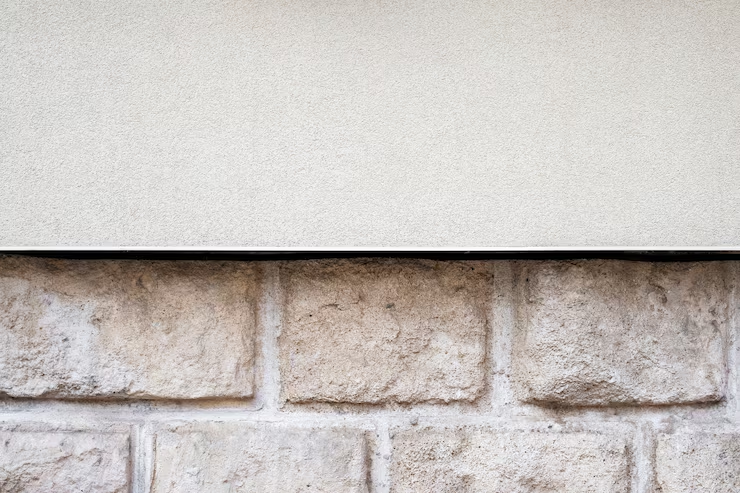
Concrete block construction is the backbone of South Florida’s building stock. CBS buildings, concrete block and stucco, make up the majority of residential and commercial structures throughout Broward County and the wider South Florida region. They are durable, wind-resistant, and well-suited to the local climate in many ways. But concrete block is not inherently waterproof, and in South Florida’s environment, an unprotected or improperly waterproofed block wall is one of the more reliable paths to interior moisture damage, mold, and structural deterioration.
Cinder block waterproofing is the process of treating concrete masonry unit walls, CMU walls, to prevent water from passing through the block, mortar joints, and the wall assembly as a whole. When it is done correctly, using the right products for the substrate and exposure conditions, it stops water intrusion at the wall face and keeps moisture from migrating into interior spaces. When it is done incorrectly, or with products that are not appropriate for the application, it creates a false sense of security while moisture continues to move through the wall behind the coating.
For building owners in South Florida, understanding what cinder block waterproofing actually involves, which products and methods work in this climate, and where the common failure points are makes the difference between a treatment that holds and one that peels off after the first hurricane season.
Why Concrete Block Walls Let Water In
Concrete block is a porous material. The block itself absorbs water, and the mortar joints between blocks are often more permeable than the block faces. Even a wall that looks solid and intact can transmit significant moisture under sustained rain or wind-driven water conditions.
Several factors specific to South Florida make this more pronounced.
Wind-driven rain During tropical storms and hurricanes, rain does not fall straight down. It is driven horizontally against building facades at high velocity, forcing water into pores, cracks, and mortar joints that would shed water under normal rainfall conditions. A block wall that performs acceptably in typical rain can allow significant intrusion during a storm event if it has not been properly waterproofed and sealed.
High humidity and vapor pressure South Florida’s year-round humidity creates a vapor pressure differential across building envelopes. Moisture in the warm, humid outdoor air pushes toward the cooler, air-conditioned interior through the wall assembly. Over time, this vapor drive carries moisture through the block and can lead to condensation, efflorescence, and mold growth on interior wall surfaces even without a visible exterior leak.
Salt air and chloride exposure Airborne chlorides from the ocean penetrate concrete block walls and attack the mortar joints and any embedded steel lintels or reinforcement within the wall assembly. As steel corrodes, it expands and cracks the surrounding masonry, creating new pathways for water intrusion. Coastal properties in Hollywood and throughout Broward County are in elevated chloride exposure zones where this process is meaningfully faster than in inland markets.
Aging mortar joints Mortar joints in older CBS construction deteriorate over time, becoming soft, crumbly, or cracked. Failed mortar joints are among the most common entry points for water in block walls and are often overlooked during surface waterproofing applications that coat the block face without addressing joint condition first.
Efflorescence as a warning sign White mineral deposits on the face of a block wall, a condition called efflorescence, are a reliable indicator that water is moving through the wall and depositing dissolved salts on the surface as it evaporates. Efflorescence does not mean the wall is failing structurally, but it does confirm that moisture transmission is active and should be addressed before it causes interior damage or progresses to mortar joint deterioration.
Waterproofing Concrete Block Walls Outside: The First Line of Defense
Exterior waterproofing is the preferred approach for CMU walls because it intercepts water at the source, before it enters the wall assembly. Keeping moisture out of the block from the start is less complicated and more durable than trying to hold it back from the interior side.
The options for waterproofing concrete block walls outside fall into a few broad categories, each with different performance characteristics and appropriate applications.
Elastomeric coatings Elastomeric waterproofing coatings are thick, flexible, paint-like products that bridge hairline cracks and surface voids in the block and mortar joint face. They are one of the most widely used exterior waterproofing solutions for CMU walls in South Florida because they accommodate the thermal movement that concrete block experiences in this climate without cracking or delaminating. A properly applied elastomeric coating on a well-prepared exterior wall provides meaningful water resistance against wind-driven rain and normal weather exposure.
The critical qualifier is preparation. Elastomeric coatings applied over a dirty, chalky, or compromised surface will fail prematurely. Loose paint, efflorescence, and failing mortar joints must be addressed before any coating is applied. A coating that bridges the surface of a deteriorated joint is not repairing it. It is hiding it temporarily.
Penetrating sealers Penetrating silane or siloxane sealers absorb into the concrete block and chemically bond with the substrate, repelling water at the pore level rather than forming a surface film. They are invisible when applied, do not change the appearance of the wall, and allow the wall to breathe while resisting liquid water intrusion. Penetrating sealers are well-suited to walls that are structurally sound and in good condition but are experiencing moisture transmission due to the natural porosity of the block.
They are not appropriate as a standalone solution when cracking, joint deterioration, or active efflorescence is present, because they do not bridge cracks or address damaged mortar.
Cementitious waterproofing Cementitious waterproofing products are cement-based coatings that bond tightly to concrete blocks and create a rigid, waterproof layer on the wall face. They are highly durable and compatible with the masonry substrate, but they do not accommodate significant movement or cracking. For exterior applications on walls that experience thermal movement or have pre-existing cracks, a more flexible system is generally preferable. Cementitious coatings are often used in combination with elastomeric top coats to combine the adhesion characteristics of cement-based products with the crack-bridging performance of elastomeric finishes.
Waterproofing Concrete Block Walls Inside: When Interior Treatment Is Needed
Interior waterproofing of CMU walls is sometimes necessary when exterior access is limited, when the exterior face of the wall is finished or clad in a way that cannot be disturbed, or when the exterior waterproofing treatment alone is not sufficient to stop moisture transmission under the hydrostatic pressure conditions present at the site.
It is important to understand the distinction between interior waterproofing and interior moisture management. Interior treatments do not stop water from entering the wall. They hold it back at the interior face and either resist the hydrostatic pressure driving water through the block or redirect that water to a drainage system before it can affect interior finishes and contents.
Crystalline waterproofing Crystalline products, typically cement-based with crystalline admixtures, are applied to the interior face of a block wall and penetrate into the concrete matrix. When exposed to water, the crystalline chemistry reacts to form insoluble crystals that fill the pores and capillaries in the concrete, reducing permeability. Crystalline products can withstand significant hydrostatic pressure from the exterior side and are used in applications like below-grade walls, crawlspace walls, and elevator pits where positive-side treatment is not practical.
Waterproof epoxy coatings Waterproof epoxy is a high-performance option for interior block wall waterproofing in applications that require chemical resistance, durability under abrasion, or a cleanable surface in addition to water resistance. Epoxy coatings form a dense, low-permeability film on the wall surface and adhere well to properly prepared concrete block. They are commonly used in commercial applications, food service spaces, and industrial environments where the demands on the wall surface go beyond moisture resistance alone.
For building owners considering waterproof epoxy on interior block walls, surface preparation is again the controlling factor. Epoxy does not tolerate a contaminated or friable substrate. Any loose material, oil, or moisture on the block surface will cause adhesion failure regardless of product quality. Properly prepared and applied waterproof epoxy on interior block walls provides a durable, long-lasting moisture barrier in the right applications.
Interior drainage systems When hydrostatic pressure is high enough that coating-based systems are unlikely to hold, the alternative is to manage the water rather than resist it. Interior drainage channel systems are installed at the base of the wall, collecting water that moves through the block and directing it to a sump or drain. This approach is more common in below-grade applications and is often combined with an interior wall coating that prevents visible moisture on the wall face above the drainage channel level.
Waterproofing Crawlspace Areas in South Florida Buildings
South Florida’s high water table and warm, humid climate create specific moisture challenges for crawlspace areas beneath buildings. While crawlspaces are less common in this region than slab-on-grade construction, they do exist in older residential and light commercial structures, and moisture management in these spaces is a meaningful concern.
Waterproofing crawlspace areas addresses both ground moisture and wall moisture. Ground moisture vapor rises through the soil and into the crawlspace, where it condenses on framing, block walls, and mechanical systems. Left unmanaged, this creates conditions favorable to mold growth and wood deterioration.
A crawlspace moisture control system typically includes a heavy-duty polyethylene vapor barrier installed across the ground surface and up the interior face of the perimeter walls, sealed at all seams and at the wall connection. In more comprehensive encapsulation systems, the entire crawlspace floor and walls are covered and the space is conditioned or ventilated to control humidity within the enclosed area.
For crawlspace perimeter walls constructed of concrete block, the interior wall face treatment should be compatible with the vapor barrier system and should address any active moisture transmission through the block before encapsulation is completed. Encapsulating a crawlspace without addressing active water intrusion through the block walls traps the moisture within the sealed space rather than eliminating it.
In South Florida, crawlspace waterproofing projects benefit from assessment of the site drainage conditions around the building perimeter. Poor grading, inadequate gutters, or landscaping that directs water toward the foundation can overwhelm any interior moisture management system and should be corrected as part of a comprehensive approach.
The Preparation Steps That Determine Whether Waterproofing Holds
Every cinder block waterproofing project lives or dies on the quality of the surface preparation. This is not a caveat. It is the controlling factor in whether any product, regardless of cost or quality, performs as intended.
Before any waterproofing product is applied to a CMU wall, the following conditions must be met.
All loose paint, coatings, efflorescence, and surface contamination must be removed. Pressure washing is a starting point, but mechanical methods are often necessary to achieve the profile and cleanliness that waterproofing products require. Failed mortar joints must be raked out and repointed with fresh mortar before the wall face treatment is applied. Cracks wider than hairline width should be routed and filled with an appropriate filler or sealant before coating. Any areas of active water seepage should be addressed with hydraulic cement or similar fast-setting products to stop active flow before the primary waterproofing system is installed. The wall surface must be at the correct moisture content for the product being applied. Some products require a damp surface for proper bond. Others require a dry substrate. Applying to the wrong moisture condition causes adhesion failure regardless of how the rest of the job is done.
Contractors who skip or rush preparation steps are the primary reason property owners end up with peeling, bubbling, or delaminating waterproofing treatments within a year or two of application.
C.A.R.E. Construction Provides Professional Waterproofing for South Florida Buildings
Moisture problems in CBS buildings in South Florida start small and expand quickly. A wall that is showing efflorescence today may be contributing to mold growth and interior damage within a season if the underlying moisture pathway is not addressed.
C.A.R.E. Construction Inc. provides professional waterproofing services for concrete block walls, crawlspace areas, and building envelopes throughout Broward County and the South Florida region. Our team assesses the full moisture picture for your building, specifies products and methods matched to the actual conditions, and delivers waterproofing that is built to perform through South Florida’s heat, humidity, and storm season.
If your block walls are showing efflorescence, interior dampness, peeling coatings, or any sign of moisture transmission, contact us for an honest assessment of what is happening and what it takes to stop it.
Call us: 954-551-0057 (Broward) | 305-962-2430 (Miami) Email: office@careconstructioninc.com Visit: careconstructioninc.com
FAQs
What is the best product for cinder block waterproofing in South Florida?
There is no single best product because the right choice depends on the wall’s location, exposure conditions, existing condition, and whether the treatment is being applied to the interior or exterior face. Elastomeric coatings work well for exterior applications on walls with minor cracking and sound mortar. Crystalline products or waterproof epoxy are better suited to interior applications under hydrostatic pressure. Penetrating sealers are appropriate for sound walls in good condition. A professional assessment determines which system fits the specific situation.
How long does cinder block waterproofing last?
Properly applied exterior elastomeric coatings on well-prepared CMU walls typically last 10 to 15 years in South Florida’s climate before recoating is needed. Crystalline interior treatments can last significantly longer. Penetrating sealers generally need renewal every 5 to 10 years depending on exposure. Products applied without adequate preparation consistently fall short of those ranges.
Can I waterproof my block wall myself?
Consumer-grade masonry waterproofing products are available, but the preparation requirements are the same regardless of who applies the product. Rental equipment for pressure washing and surface preparation is available, but the sequencing, material selection, and preparation standards that determine whether the treatment holds require experience that most property owners do not have. For walls with active moisture intrusion, structural concerns, or significant surface deterioration, professional assessment and application is the appropriate approach.
What causes waterproofing to fail on block walls?
The most common causes are inadequate surface preparation, failed or missing mortar joint repair prior to coating, applying products in unsuitable weather or temperature conditions, using products that are not appropriate for the substrate or exposure, and skipping primer or bonding coats that the product specification requires.
Does cinder block waterproofing require a permit in Broward County?
Surface waterproofing treatments on existing walls generally do not require permits. Work that involves structural repair, below-grade drainage systems, or is part of a larger renovation or restoration project may require permits. A licensed contractor familiar with Broward County requirements can advise on the permit status of a specific project scope.