A deck over a living space sounds like a great use of square footage until rain starts pooling and working its way through. In South Florida, where rainfall during storm season can drop several inches in a single afternoon, an unprotected or poorly waterproofed deck is not a minor inconvenience. It is an active threat to whatever is underneath: a garage, an enclosed patio, a bedroom, a storage area, or finished interior space.
Under deck waterproofing is the system that stops that from happening. It keeps water from penetrating the deck surface, protects the structural substrate below, and preserves the usability of the space underneath regardless of what the weather is doing above. For property owners in South Florida, it is also more technically demanding than in most other markets. The combination of humidity, UV exposure, thermal cycling, and hurricane-season rainfall creates conditions that stress waterproofing systems faster and more aggressively than anywhere else in the country.
This guide covers how under deck waterproofing works, what the common failure points are in South Florida’s climate, how it relates to other waterproofing applications on the same property, and what to look for in a contractor.
What Under Deck Waterproofing Actually Does
The term gets used loosely, so it is worth being precise. Under deck waterproofing refers to a system applied to a deck surface, or to the underside of a deck structure, that prevents water from passing through to the space below.
The approach varies depending on the deck type and what the space below looks like.
For a concrete deck over a garage or enclosed space, a waterproofing membrane is applied to the top surface of the concrete. The membrane does the work of capturing water before it can penetrate the slab and reach the ceiling or walls of the space below. These systems typically use fluid-applied polyurethane or epoxy-based membranes, sometimes combined with reinforcing fabric, and are finished with a wearing course that handles foot traffic and UV exposure.
For elevated wood or composite decks over a living space, the approach is often different. A trough-and-drain system is installed beneath the deck boards, collecting water that falls between boards and channeling it away from the structure. These systems protect the framing below and allow the space underneath to remain dry and usable, but they do not form a true waterproof seal the way a membrane-applied system does on concrete.
For elevated walkways, balconies, and plaza decks connected to a building envelope, the waterproofing scope expands to include the transitions between the horizontal surface and the adjacent walls, parapets, and drainage components. These transition zones are where most waterproofing failures begin.
In South Florida, the most commonly encountered under deck applications involve concrete substrates, given the prevalence of CBS construction and concrete decking on commercial and multifamily residential buildings throughout Broward County and the surrounding region.
Why South Florida’s Climate Makes This Harder
Waterproofing a deck over living space anywhere requires care. Doing it in South Florida requires an additional layer of planning because several regional factors accelerate the conditions that cause waterproofing systems to fail.
UV degradation Rooftop and deck surfaces in South Florida receive intense ultraviolet radiation year-round. Many waterproofing membranes degrade under sustained UV exposure, becoming brittle, losing adhesion, or developing surface cracking that allows water to work underneath. Systems specified for South Florida must either use UV-stable formulations or be protected with a top coat that absorbs and reflects solar radiation before it reaches the membrane layer.
Thermal cycling Deck surfaces in this region expand and contract significantly between daytime highs and overnight temperatures. Concrete decks move with these temperature changes, and any waterproofing system applied to them must be flexible enough to accommodate that movement without cracking or delaminating at joints, edges, or penetrations. Rigid coatings that perform adequately in milder climates often fail here within a few years.
Humidity and vapor drive South Florida’s year-round humidity creates a vapor pressure differential that pushes moisture through building materials from the exterior inward. In waterproofing applications, this means the substrate must be properly prepared and the moisture content of the concrete must be within acceptable limits before any membrane is applied. Trapping moisture beneath a waterproofing layer causes adhesion failure, blistering, and eventual delamination.
Storm season rainfall intensity During peak hurricane season months, Broward County regularly receives rainfall at intensities that overwhelm inadequately designed drainage systems. Under deck waterproofing systems must be paired with properly designed and maintained drainage: correctly sloped surfaces, functional drains, and scuppers that can handle high-volume water events without backing up and allowing ponding against walls, transitions, or penetrations.
Waterproofing a Deck Over Living Space: What the System Includes
A complete under deck waterproofing installation on a concrete deck over a living space involves more than applying a membrane to the flat surface. Every component of the system has to work together, and the weakest element determines how long the whole installation holds up.
Surface preparation Concrete must be cleaned, repaired, and profiled before any membrane is applied. Cracks, spalls, and delaminated areas need to be addressed first. Existing coatings or failed membranes must be removed. If any waterproofing is applied over a compromised substrate, the new system inherits the problems underneath.
Crack bridging Concrete cracks. In South Florida, thermal movement and settlement make this essentially inevitable over time. A waterproofing system without adequate crack-bridging capability will develop failures at those locations regardless of how well the rest of the application was executed. Elastomeric membranes with sufficient elongation properties are specified for this reason.
Membrane application Depending on the system, the membrane may be fluid-applied in one or two coats, sheet-applied and heat-welded, or a combination of both. Fluid-applied systems are well-suited to complex geometries and surfaces with multiple penetrations, because they conform to irregular shapes without seams. Sheet systems offer consistent thickness but require careful detailing at transitions and terminations.
Transition and termination detailing The points where the membrane meets walls, curbs, columns, drains, and edges are where water most often finds a path through. These transitions require special detail work: fabric reinforcement embedded in the membrane, appropriate termination heights above the finished surface level, and counterflashing or sealant at the top edge to prevent water from traveling behind the membrane from above.
Wearing course or protective layer The waterproofing membrane itself is not designed to handle direct foot traffic, furniture loads, or prolonged UV exposure without protection. A wearing course, either a traffic-rated coating or pavers on pedestals, protects the membrane and extends system life.
Drainage Slope, drain placement, and drain capacity must be designed to move water off the surface before it has time to sit and find a path through any weak point in the system. This is especially critical in South Florida where rainfall events can be sudden and intense.
How Under Deck Waterproofing Connects to Other Building Waterproofing
Property owners who are addressing an under deck waterproofing issue often find that it is connected to other moisture problems in the building. Understanding how these applications relate to each other helps with prioritization and avoids the common mistake of fixing one entry point while leaving others open.
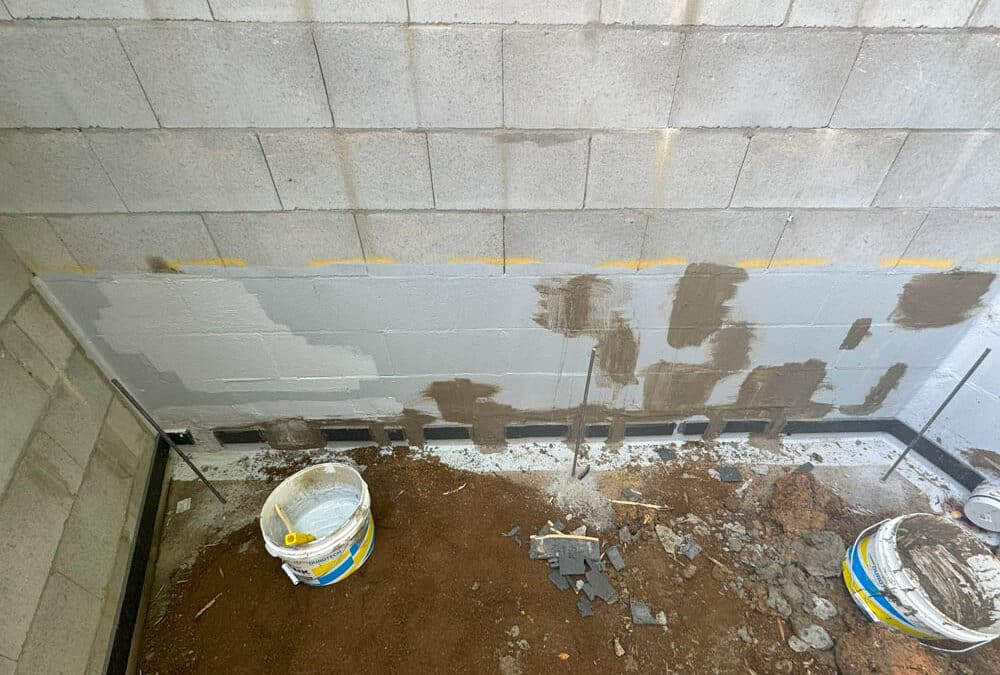
Waterproofing concrete block walls inside CBS buildings in South Florida, which make up the majority of the residential and commercial building stock, are vulnerable to moisture transmission through the block wall assembly itself. When a deck over a living space is adjacent to a block wall, water that penetrates the deck surface can also travel through the wall connection and appear as interior dampness or efflorescence on the interior face of the block. Addressing under deck waterproofing without also evaluating the wall connection leaves a significant pathway open. Interior waterproofing of concrete block walls using crystalline or elastomeric coatings is sometimes done in combination with exterior deck membrane work to address this comprehensively.
Waterproofing crawlspace For properties with crawlspace areas below grade or beneath elevated structures, moisture control is a separate but related concern. Ground moisture in South Florida’s high water table environment can move upward through crawlspace floors and framing, contributing to mold, wood rot, and compromised indoor air quality. Vapor barriers, drainage matting, and encapsulation systems address crawlspace moisture differently than a deck membrane addresses surface water intrusion, but both belong to the same overall moisture management picture for a building.
Shower waterproofing Interior wet areas, particularly showers and wet rooms, are another common source of water damage in South Florida properties. The failure mode is different from a deck: instead of rainwater penetrating from above, shower waterproofing failures allow water to migrate behind tile and into adjacent walls or floor assemblies over time. When a property is experiencing multiple water intrusion issues simultaneously, it is worth assessing all potential sources together rather than assuming that addressing the most visible problem will resolve the others.
Common Under Deck Waterproofing Failures in South Florida
Understanding what causes failures helps property owners recognize warning signs early and evaluate contractor proposals with more confidence.
Inadequate surface preparation This is the most common root cause of premature waterproofing failure. A membrane applied over contaminated, cracked, or damp concrete will not achieve proper adhesion and will begin to delaminate under thermal cycling and foot traffic. Proper surface prep takes time and adds to project cost, which is why it is often where corners get cut.
Incompatible products Not every waterproofing product is appropriate for every substrate or exposure condition. A system rated for interior use will not perform on a south-facing deck in direct sun. Products that do not meet Florida Building Code product approval requirements create both performance and code compliance problems.
Poor transition detailing The flat field of a membrane typically holds up reasonably well. The details at drains, curbs, walls, and edges are where failure concentrates. Insufficient membrane height at vertical transitions, inadequate counterflashing, and gaps in sealant at terminations are all common findings during water intrusion investigations.
Deferred maintenance Waterproofing systems are not permanent. Wearing courses need periodic renewal, sealants at transitions require re-application over time, and drains need to be kept clear. Property owners who treat a waterproofing installation as a one-time fix without any ongoing maintenance typically see failures well before the system reaches its expected service life.
What to Ask a Waterproofing Contractor Before Signing Anything
The waterproofing market includes a wide range of operators, and the quality difference between a contractor who understands South Florida’s specific conditions and one who does not shows up in the durability of the finished installation. A few direct questions help filter the field.
What products do you specify, and are they Florida Product Approved for this application? The answer should be specific, not general. A contractor who cannot name the system they plan to install is not in a position to stand behind it.
How do you handle substrate preparation, and what happens if we find additional damage during prep? Surface preparation scope often changes once work begins, and understanding how a contractor handles that discovery affects both the project outcome and the final cost.
What does the transition detailing look like at drains, walls, and edges? Ask to see photos of completed details from prior jobs. The quality of that work is usually a reliable indicator of overall installation quality.
What is the expected service life of the system, and what does it require in terms of maintenance? Any legitimate answer includes both a service life range and a maintenance protocol. Systems that are described as maintenance-free should be evaluated carefully.
Is your company licensed as a general contractor or roofing contractor in Florida, and will this work be permitted? For work involving structural substrates or building envelopes in Broward County, proper licensing and permits are not optional.
Talk to C.A.R.E. Construction About Your Property
Moisture problems in South Florida rarely stay contained. A deck that is letting water through today is affecting the structure, the space below, and potentially the adjacent walls and building envelope. The sooner the system is assessed and addressed, the less ground that water has to cover.
C.A.R.E. Construction Inc. provides professional waterproofing services for residential and commercial properties throughout South Florida, including under deck systems, balcony and plaza deck membranes, concrete block wall waterproofing, and full building envelope assessments. Our team is licensed, insured, and experienced with the specific products, conditions, and code requirements that South Florida waterproofing demands.
If you have a deck over a living space that is showing signs of moisture intrusion, or if you want an assessment before a problem develops, reach out to our team for a straightforward evaluation.
Call us: 954-551-0057 (Broward) | 305-962-2430 (Miami) Email: office@careconstructioninc.com Visit: careconstructioninc.com
Frequently Asked Questions
How long does under deck waterproofing last in South Florida?
A properly installed system with appropriate products and regular maintenance typically delivers 10 to 15 years of service life in South Florida’s climate. Systems that are exposed to heavy UV without a protective top coat, or that are installed over inadequately prepared substrates, often fail significantly earlier.
Can I waterproof a deck over a living space myself?
Consumer-grade coatings are available, but they are not the same as the elastomeric or polyurethane systems used in professional waterproofing installations. In South Florida’s climate, DIY applications on a deck over occupied space carry significant risk of premature failure and the water damage that follows. For any deck over a habitable space, professional installation with proper surface prep and system specification is the appropriate approach.
How do I know if my under deck waterproofing has failed?
Water staining on the ceiling of the space below is the most obvious sign. Other indicators include efflorescence on concrete surfaces below the deck, damp or musty odors in the space below, visible cracks or blistering in the deck surface coating, and standing water after rain that does not drain within a reasonable time. Any of these warrants a professional assessment before more interior damage occurs.
Does under deck waterproofing require a permit in Broward County?
It depends on the scope. Surface coatings on existing decks may not require permits. Work that involves structural repairs, changes to drainage systems, or is part of a larger renovation project typically does. A licensed contractor familiar with Broward County’s building department requirements can advise on permit requirements for a specific project.