A few cracks or small pieces of broken concrete may not seem like enough to justify a major concern. On balconies, parking garages, exterior walls, and other concrete areas, those defects are often easy to put off until the damage becomes more obvious.
The problem is that the amount of deterioration you can see does not always tell you how much repair the building may actually need.
For property managers and condo boards, knowing when damaged concrete is simply a surface issue and when it may be pointing to a larger restoration problem can affect how quickly the issue is addressed and how costly the repair eventually becomes.
This guide will help you recognize concrete spalling, understand the conditions that can lead to it, and know what to consider before deciding how the damaged area should be repaired.
What Is Concrete Spalling?
Concrete spalling occurs when sections of concrete crack, flake, chip, separate, or break away from the main concrete element.
Damage can remain relatively shallow or extend far enough to expose reinforcing steel. The seriousness of the condition depends on its cause, location, depth, and effect on the surrounding structure.
Spalling should not automatically be confused with an ordinary surface chip.
Concrete can be damaged by impact or normal wear. Spalling becomes more concerning when deterioration is developing beneath the surface, particularly when rust staining, exposed reinforcing steel, delamination, or recurring cracking accompanies the visible damage.
What Causes Concrete Spalling?
Several conditions can contribute to spalling, and South Florida buildings can experience more than one simultaneously.
Reinforcing Steel Corrosion
Corrosion of reinforcing steel is one of the most significant causes of concrete spalling.
Concrete normally creates an environment that helps protect embedded reinforcement. Over time, moisture and chlorides can reach the steel and compromise that protection.
When reinforcement corrodes, the corrosion products occupy more volume than the original steel. That expansion places pressure on surrounding concrete.
Cracking can begin along the reinforcement before the concrete eventually separates or falls away.
This pattern is especially relevant on coastal properties where moisture and airborne salts are part of the building’s long-term exposure.
Water Intrusion
Water can reach concrete through cracks, joints, balconies, failed deck coatings, roof leaks, exterior walls, deteriorated sealants, and other weaknesses in the building envelope.
When that exposure continues, corrosion and concrete deterioration can progress.
This is why concrete repair and waterproofing frequently need to be considered together.
Repairing the damaged concrete without addressing an active water-entry problem can leave surrounding areas exposed to the same conditions.
Coastal Conditions
South Florida combines humidity, frequent rainfall, wind-driven moisture, heat, and coastal salt exposure.
These conditions do not automatically cause reinforced concrete to fail, but they increase the importance of protecting the concrete and repairing pathways that allow moisture and chlorides to reach reinforcement.
Buildings near the coast deserve particularly close attention when rust staining and spalling begin appearing.
Cracks and Failed Protective Systems
Cracks can provide paths for moisture and contaminants.
Failed deck coatings, deteriorated joint sealants, worn waterproofing systems, and poorly maintained transitions can create similar vulnerabilities.
The visible spall may therefore be connected to a much larger maintenance issue.
Where Does Concrete Spalling Commonly Appear?
On condominiums and commercial buildings, spalling frequently develops in areas with repeated exterior exposure.
Balcony slab edges and undersides are common locations because they receive frequent rain and can be affected by failed deck waterproofing or railing penetrations.
Parking garages can develop deterioration on slabs, beams, columns, ramps, and ceilings when moisture moves through cracks, joints, or traffic surfaces.
Exterior walls, structural beams, columns, catwalks, and elevated decks can also be affected.
The location matters because falling concrete from an elevated surface can create a safety concern for residents, pedestrians, vehicles, or occupied spaces below.
What Are the Warning Signs of Concrete Spalling?
The first warning sign is not always a large missing piece of concrete.
Rust Staining
Orange or brown stains can indicate corrosion associated with embedded steel.
Rust staining does not establish the severity of the condition, but when it appears with cracks or surface deterioration, further evaluation is appropriate.
Cracking Along Reinforcement
Corrosion-related pressure can produce relatively straight cracks that follow reinforcing bars beneath the surface.
A crack that repeatedly returns after patching should not simply be sealed again without investigating why it is forming.
Hollow or Delaminated Concrete
Concrete can begin separating internally before it falls.
Professionals may use sounding or other evaluation methods to identify hollow or delaminated areas surrounding visible damage.
This explains why repair quantities sometimes grow after a restoration project begins.
Exposed Reinforcing Steel
Once reinforcement is visible, the concrete cover protecting that steel has already been lost.
The steel condition and surrounding concrete then need to be evaluated as part of the repair.
Falling Concrete
Falling material requires prompt attention, particularly above entrances, sidewalks, balconies, pool areas, parking spaces, and other occupied locations.
The surrounding area may contain additional loose concrete even if it still appears attached.
Is Concrete Spalling a Structural Problem?
It can be, but not every spall means a building is structurally unsafe.
The answer depends on the affected component, depth of deterioration, amount of reinforcement damage, cracking pattern, and overall condition.
Spalling involving beams, columns, structural slabs, post-tension systems, parking structures, or widespread balcony deterioration may require evaluation by a Florida-licensed architect or structural engineer.
The design professional determines structural repair requirements. The contractor then performs the construction according to the applicable repair documents and specifications.
How Is Concrete Spalling Repaired?
A lasting repair begins with understanding the extent and cause of deterioration.
Damaged Concrete Is Removed
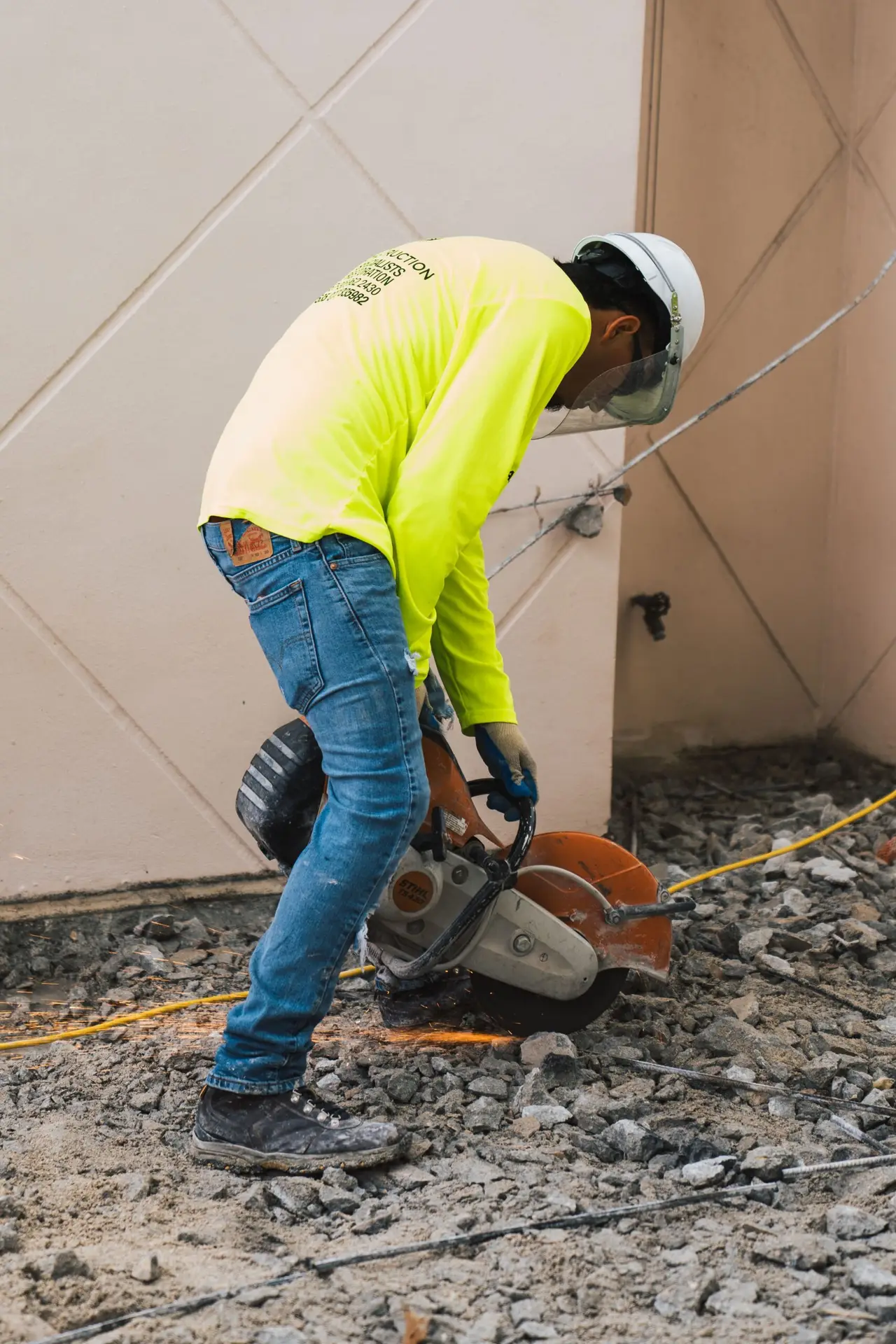
Loose, deteriorated, and delaminated concrete is removed until a suitable repair substrate is reached.
The actual repair boundary may extend beyond the section that was visibly missing.
Reinforcement Is Evaluated
Exposed reinforcing steel is cleaned and evaluated.
Depending on its condition, the repair may require corrosion treatment, additional steel, replacement, or other work specified by the engineer.
Simply covering rusted reinforcement with a thin patch does not address active deterioration.
The Concrete Section Is Restored
The damaged area is rebuilt using appropriate repair material and procedure.
The system selected depends on factors such as repair depth, orientation, exposure, structural requirements, and compatibility with the existing concrete.
Water Intrusion Is Addressed
If water contributed to the deterioration, the source should be corrected.
That may involve balcony waterproofing, deck coatings, joint sealants, crack repair, roof repairs, exterior waterproofing, or other building-envelope work.
This step is important because a successful patch cannot stop water entering from another location.
Why Repeated Patches Fail
When the same concrete area keeps spalling after repair, the previous work may have addressed only the visible damage.
Corroded reinforcement may remain outside the patch. Adjacent concrete may already be delaminated. Water may still be entering through a failed waterproofing system.
A proper restoration project considers the concrete, reinforcement, surrounding deterioration, and source of moisture as connected conditions.
Address Concrete Spalling Before It Spreads
Concrete spalling should not be judged only by the size of the piece that has fallen.
The deterioration may extend into surrounding concrete, involve corroding reinforcement, or indicate an active moisture problem elsewhere in the building envelope.
C.A.R.E. Construction provides concrete restoration services throughout South Florida, including concrete spalling repair, balcony and catwalk repairs, structural garage restoration, beam and column repair, post-tension cable repair, waterproofing, deck restoration, and related exterior work.
If your property has rust staining, cracked or falling concrete, exposed reinforcement, or previous repairs that continue failing, contact C.A.R.E. Construction to evaluate the restoration work required before the affected area becomes larger.
Frequently Asked Questions About Concrete Spalling
Is concrete spalling dangerous?
Concrete spalling can become dangerous when loose pieces are located above walkways, parking areas, balconies, entrances, pool decks, or other occupied spaces. Falling concrete can create an immediate safety hazard. Spalling can also indicate deterioration around reinforcing steel, so the affected area should be evaluated rather than treated as a cosmetic problem.
What does concrete spalling look like?
Concrete spalling may appear as flaking, chipping, cracking, missing sections, exposed reinforcing steel, rust-colored staining, or areas where the surface appears to be separating from the concrete below. In some cases, the visible damaged area is smaller than the surrounding section that has already begun to deteriorate.
What is the main cause of concrete spalling?
One of the most common causes is corrosion of reinforcing steel inside the concrete. Moisture and chlorides can reach the reinforcement, allowing corrosion to develop. As the steel corrodes, it expands and places pressure on the surrounding concrete, which can eventually cause cracking and spalling.
Can water intrusion cause concrete spalling?
Yes. Repeated water intrusion can contribute to reinforcement corrosion and concrete deterioration. Water may enter through cracks, failed sealants, deteriorated waterproofing, balcony coatings, exterior walls, roof problems, joints, or other openings in the building envelope.
Can concrete spalling be repaired without replacing the entire slab?
Often, yes. Localized spalling may be repaired by removing damaged concrete, preparing or repairing the exposed reinforcement, and rebuilding the affected section with an appropriate repair material. More extensive deterioration may require larger repairs, particularly when structural components or widespread reinforcement corrosion are involved.
Can you simply patch over spalling concrete?
A surface patch may not provide a lasting repair if deteriorated concrete or corroded reinforcement remains underneath it. Proper concrete restoration usually requires removal of unsound material, evaluation of the reinforcing steel, preparation of the repair area, and correction of contributing moisture problems where necessary.
How do you know if concrete spalling is structural?
The appearance of the concrete alone may not be enough to determine whether structural capacity has been affected. Spalling involving beams, columns, elevated slabs, parking garages, balconies, post-tensioned systems, or widespread areas may require evaluation by a qualified architect or structural engineer.
Why is concrete spalling common in South Florida?
South Florida buildings are exposed to high humidity, heavy rainfall, wind-driven moisture, and coastal salt conditions. Moisture and chlorides can penetrate concrete over time and contribute to reinforcement corrosion, especially where cracks, failed waterproofing, inadequate concrete cover, or deteriorated coatings are present.
What happens if concrete spalling is not repaired?
If the conditions causing the deterioration continue, spalling can spread into adjacent concrete. Reinforcing steel may continue corroding, additional concrete may loosen or fall, and the eventual repair scope can become larger and more expensive.
How long does a concrete spalling repair last?
The service life of a repair depends on the extent of the original deterioration, preparation of the damaged area, condition of the reinforcement, repair materials used, workmanship, environmental exposure, and whether the underlying source of moisture or chloride exposure has been addressed. A properly designed repair should address the cause of deterioration rather than only replace the missing concrete.
Does concrete spalling mean the rebar has rusted?
Not always, but reinforcement corrosion is a common cause of spalling in reinforced concrete. Rust stains, exposed steel, cracks running along reinforcement, and repeated deterioration can be signs that corrosion is involved. The affected area should be opened and evaluated to determine the actual condition of the reinforcement.
Can waterproofing help prevent concrete spalling?
Waterproofing can help reduce moisture penetration when water intrusion is contributing to the deterioration. Depending on the property, this may involve balcony coatings, deck waterproofing, joint sealants, exterior wall systems, garage coatings, caulking, or other protective systems. Waterproofing does not replace damaged concrete, but it can be an important part of preventing continued exposure after repairs are completed.